Understand crown, wire section and leg length, and distinguish nominal inch sizes from exact conversion using Skobex catalogue examples.
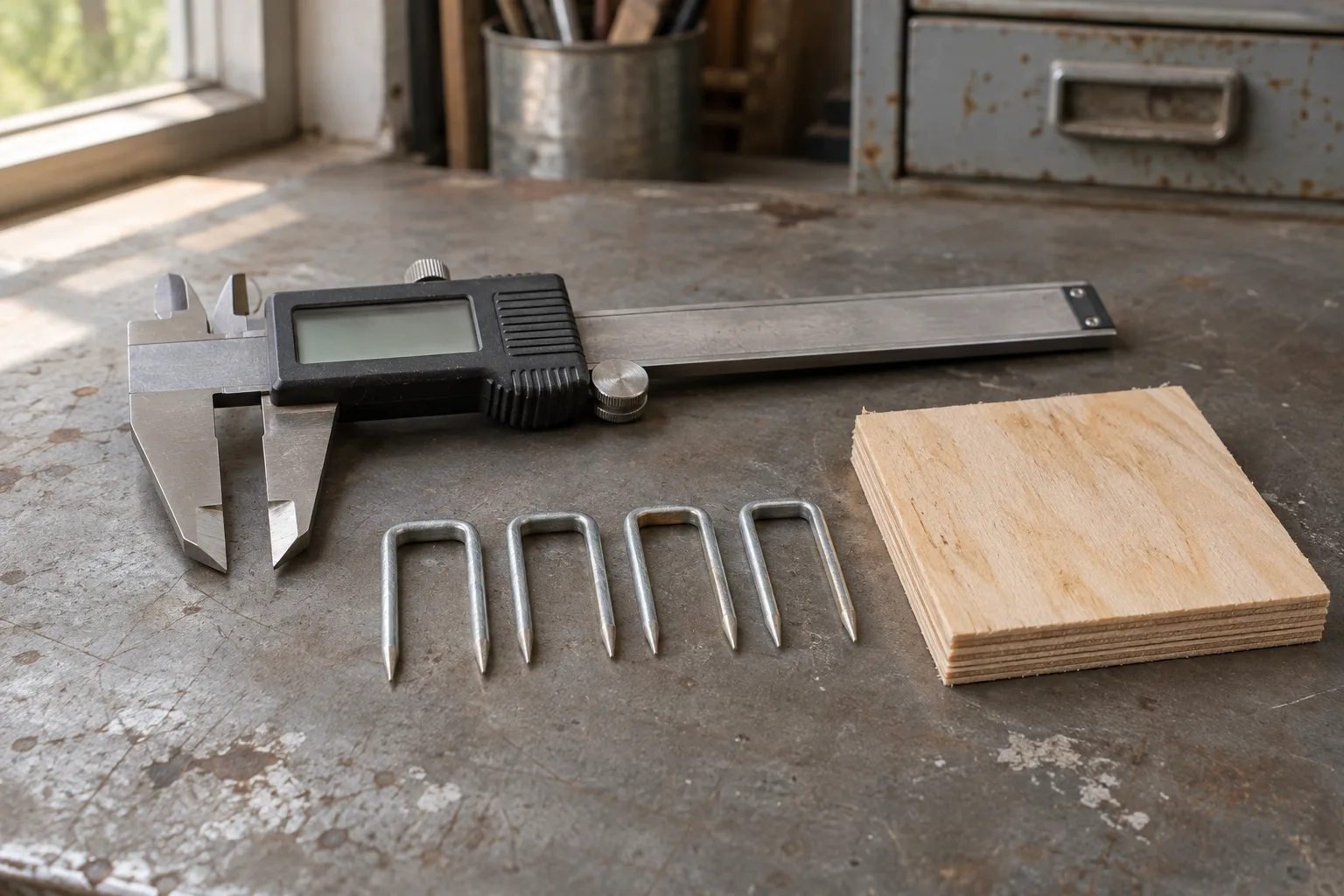
A staple specification contains several numbers, but they describe different parts of the fastener. Before comparing two products, establish which dimension each number represents. Crown width, wire cross-section and leg length should appear separately, with units. The word “width” on its own can refer either to the crown or to one side of the wire section, so a drawing is useful.
Three dimensions answer different questions
The crown is the top section between a staple’s legs. Wire cross-section may be expressed as two numbers, such as 0.75 × 0.60 mm. These are not two leg lengths. Where lengths are provided, they belong in a separate field; the latest Skobex table has no such field, so state the required length in the enquiry.
Compare actual catalogue examples
The latest table gives Model 71 a 9.00 mm / 0.354 inch crown and 0.75 × 0.60 mm wire. Model 380 has a 12.80 mm / 0.504 inch crown and 0.90 × 0.70 mm wire. Both are fine-wire staples, but their actual dimensions differ. A category name does not establish an identical product or confirm tool compatibility.
Exact conversion and nominal sizes
The NIST explanation of length units states that one inch is exactly 25.4 mm. For an order, use the decimal-inch entries supplied in the latest product table rather than fractions in an older drawing. For example, the table gives the Model 71 crown as 9.00 mm and 0.354 inch. These nominal entries do not establish a manufacturing tolerance.
Resolve conflicting documents explicitly
If a drawing and the latest table disagree, identify the conflict and document version. Current product dimensions on this website follow the latest corrected table. Older drawings containing lengths not confirmed in that table are not presented as current specifications. For omitted dimensions, state the exact model and required size in the enquiry.
Use the same specification for ordering and receiving
A clear order line states the model, crown, wire section, leg length and controlling measurement unit. Agree any required tolerance and measurement method separately. C-rings, L-cleats and wire band need their own drawings: terms describing a U-shaped staple should not be forced onto a different geometry. A photograph can support identification, but should not replace a dimensioned specification.
For brads, read the head and collation angle
A brad does not have the crown of a U-shaped staple. The updated Skobex table gives BR12 a 1.25 × 1.00 mm wire section and a 2.00 mm head; keep those fields separate. DA Brads is listed at 34°, 15 GA, with 1.76 × 1.76 mm wire and a 3.20 mm head. The latest table does not provide lengths; confirm the required length and this model’s availability in your enquiry.
Keep the approved version with the purchase order. At goods receipt, compare the delivery against that version, rather than an old screenshot. If a dimension is unclear, provide a photograph showing the proposed measurement points. Send the measurements and source document so the unresolved detail can be checked before the order is released.
Sources
- SI Units – Length — NIST