Start staple selection with the tool, crown, wire and materials. A practical specification check before ordering for production.
Choose an industrial staple for the joint, rather than for a familiar number on a box. The same leg length may be available with different crown widths and wire sections. An enquiry for “25 mm staples” therefore leaves several important questions unanswered. The following sequence helps turn an initial requirement into a usable purchasing specification without assuming that visually similar fasteners are interchangeable.
1. Identify the complete tool model
Record the tool manufacturer and full model designation, including any suffix. Find the specified fastener series and permitted length range in its instructions. If you have an existing box, keep its label and an undamaged staple strip. A front-view photograph cannot show every dimension, and a similar series name is not confirmation that a different fastener will fit the tool.
2. Compare three dimensions separately
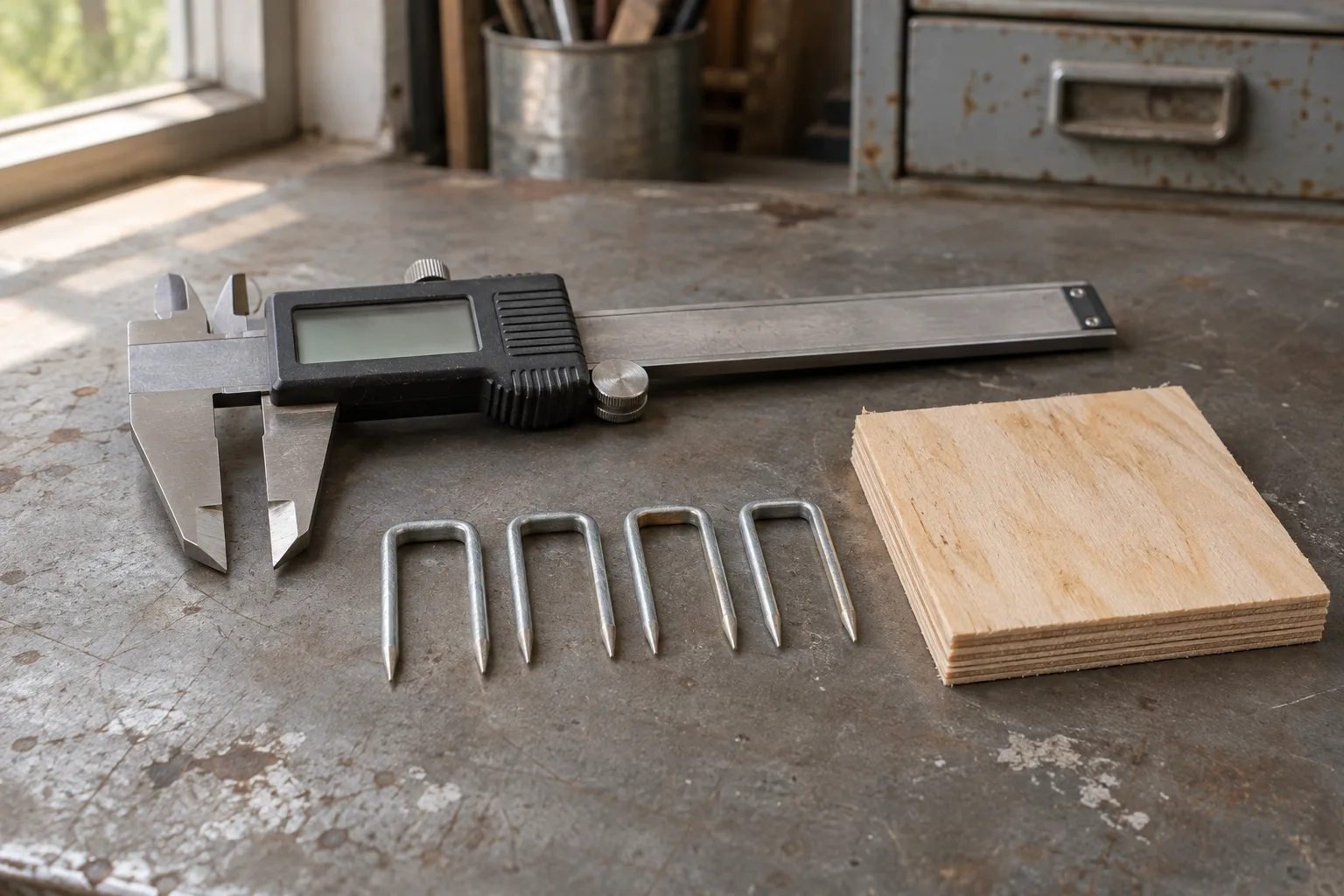
Check crown width and wire cross-section. The latest Skobex table gives Models L and 92 the same 1.25 × 1.05 mm wire, but crowns of 5.70 and 8.70 mm respectively. These are independent models, not automatic equivalents. State the required leg length in the enquiry: the latest table does not provide a length list.
3. Describe both materials in the joint
State the upper material, its thickness and the substrate. Upholstery fabric on a wooden frame, a trim component and carton flaps are different applications. Note whether the joint is visible, whether surface damage matters and the expected service conditions. SENCO’s staple anatomy guide provides useful terminology. It is background information, rather than approval of a particular Skobex fastener for a particular tool.
4. Select a candidate, not a guarantee
Start with the product type and application actually listed in the table. Flooring staples FSS have a separate flooring category; CC35 belongs to carton closing. The latest table does not specify lengths, point types or surface finishes. Where these matter, state the requirements in the enquiry and agree the exact variant.
5. Validate and record the result
Evaluate samples with the intended tool and actual production materials, following the tool manufacturer’s instructions. Record the exact product code, length, material combination and observations. Where a joint has load or other technical requirements, the person responsible for the finished product must establish an appropriate evaluation. A catalogue description is not a structural assessment or a substitute for an application-specific test.
A useful enquiry includes the tool model, product code or old label, all three dimensions, materials and required quantity. Identify any unknowns explicitly. This lets the supplier check a specific gap instead of guessing from a single measurement. Browse the Skobex models and send the specification with the information you already have.
Sources
- Anatomy of a Staple — SENCO